Does Hp Printer L7650 Have Problem With Giving False Reading Bad Printheads

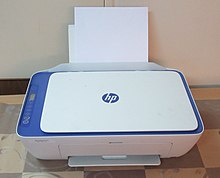
A modern HP Deskjet 2630 all in 1 printer
Inkjet printing is a type of computer press that recreates a digital paradigm past propelling droplets of ink onto paper and plastic substrates.[1] Inkjet printers were the most unremarkably used type of printer in 2008,[2] and range from small inexpensive consumer models to expensive professional machines. By 2019, laser printers outsold inkjet printers by nearly a 2:ane ratio, 9.six% vs five.1%.[iii]
The concept of inkjet printing originated in the 20th century, and the technology was first extensively adult in the early 1950s. While working at Canon in Nihon, Ichiro Endo suggested the idea for a "Bubble jet" printer, while around the same time Jon Vaught at HP was developing a similar idea.[4] In the late 1970s, inkjet printers that could reproduce digital images generated by computers were developed, mainly by Epson, Hewlett-Packard (HP) and Canon. In the worldwide consumer market place, four manufacturers account for the bulk of inkjet printer sales: Canon, HP, Epson and Brother.
In 1982, Robert Howard came up with the idea to produce a pocket-size color press organization that used piezos to spit drops of ink. He formed the company, R.H. (Robert Howard) Research (named Howtek, Inc. in Feb 1984), and developed the revolutionary technology that led to the Pixelmaster colour printer with solid ink[five] using Thermojet technology. This technology consists of a tubular unmarried nozzle acoustical moving ridge drop generator invented originally by Steven Zoltan in 1972 with a glass nozzle and improved past the Howtek inkjet engineer in 1984 with a Tefzel molded nozzle to remove unwanted fluid frequencies.
The emerging ink jet material deposition market also uses inkjet technologies, typically printheads using piezoelectric crystals, to deposit materials direct on substrates.
The technology has been extended and the 'ink' can now also comprise solder paste in PCB assembly, or living cells,[half dozen] for creating biosensors and for tissue engineering.[7]
Images produced on inkjet printers are sometimes sold under trade names such every bit Digigraph, Iris prints, giclée, and Cromalin.[8] Inkjet-printed art reproductions are normally sold under such trade names to imply a higher quality production and avert association with everyday printing.
Methods [edit]
Fluid surface tension naturally pulls a stream into droplets. Optimal driblet sizes of 0.004 inch require an inkjet nozzle size of most 0.003 inches. Fluids with surface tension may be h2o based, wax or oil based and even melted metal alloys. Most drops tin can exist electrically charged. There are two chief technologies in use in contemporary inkjet printers: continuous (CIJ) and drib-on-need (DOD). Continuous inkjet ways the flow is pressurized and in a continuous stream. Drop-on-demand means the fluid is expelled from the jet nozzle ane driblet at a time. This can exist washed with a mechanical means with a push or some electrical method. A large electric accuse tin can pull drops out of a nozzle, audio waves can push fluid from a nozzle or a bedroom volume expansion can expel a drop. Continuous streaming was investigated first many years ago. Drop-on-demand was only discovered in the 1920s.
Continuous inkjet [edit]

Schematic diagram of a continuous inkjet printing process
The continuous inkjet (CIJ) method is used commercially for marking and coding of products and packages. In 1867, Lord Kelvin patented the syphon recorder, which recorded telegraph signals equally a continuous trace on paper using an ink jet nozzle deflected by a magnetic ringlet. The first commercial devices (medical strip chart recorders) were introduced in 1951 by Siemens.[9] using the patent US2566443 invented by Elmquist Rune dated 9/four/1951.
In CIJ technology, a loftier-pressure pump directs liquid ink from a reservoir through a gunbody and a microscopic nozzle (usually .003 inch diameter), creating a continuous stream of ink droplets via the Plateau-Rayleigh instability. A piezoelectric crystal may exist used to create an acoustic wave as information technology vibrates within the gunbody and causes the stream of liquid to intermission into aerosol at regular intervals: 64,000 to 165,000 irregular-sized ink droplets per second may be accomplished.[10] The ink droplets are subjected to an electrostatic field created by a charging electrode or by a magnetic flux field as they form; the field varies co-ordinate to the degree of drop deflection desired. This results in a controlled deflection by electrostatic charge on each droplet. Charged aerosol may be separated by i or more than uncharged "baby-sit droplets" to minimize electrostatic repulsion between neighboring droplets.
The droplets pass through some other electrostatic or magnetic field and are directed (deflected) by electrostatic deflection plates or flux field to impress on the receptor fabric (substrate), or allowed to continue on deflected to a drove gutter for re-utilize. The more highly charged droplets are deflected to a greater degree. Only a pocket-size fraction of the droplets is used to print, the majority being recycled.
CIJ is i of the oldest (1951) ink jet technologies in use and is fairly mature. Driblet-on-demand was non invented until afterwards. The major advantages of CIJ are the very high velocity (≈20 g/due south) of the ink droplets, which allows for a relatively long altitude betwixt print head and substrate, and the very loftier drib ejection frequency, allowing for very loftier speed printing. Another advantage is freedom from nozzle bottleneck as the jet is always in use, therefore allowing volatile solvents such equally ketones and alcohols to be employed, giving the ink the power to "bite" into the substrate and dry out quickly.[10] The ink system requires active solvent regulation to counter solvent evaporation during the fourth dimension of flight (fourth dimension betwixt nozzle ejection and gutter recycling), and from the venting process whereby air that is fatigued into the gutter along with the unused drops is vented from the reservoir. Viscosity is monitored and a solvent (or solvent blend) is added to counteract solvent loss.
In the later 1950s heated wax inks became pop with CIJ technologies. In 1971 Johannes F. Gottwald patent US3596285A, Liquid Metal Recorder used molten metallic ink with a magnetic flux field to fabricate formed symbols for signage. This may take been the first 3D metal object printed using magnetic core memory as data to produce each symbol.
Drib-on-demand [edit]
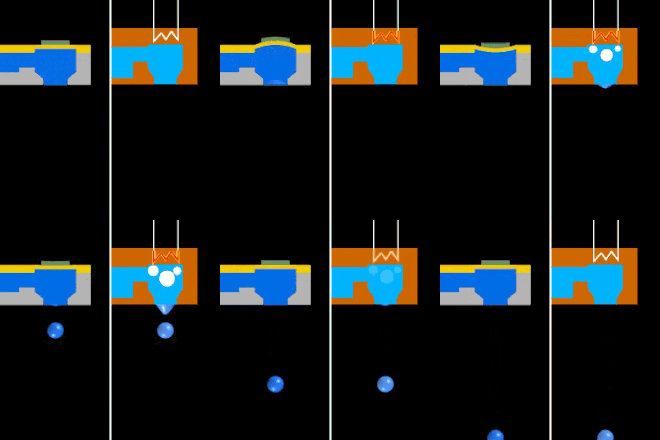
Piezoelectric (left) and thermal (right) drop generation schematic. A print caput will incorporate several such nozzles, and will be moved beyond the folio as paper advances through the printer
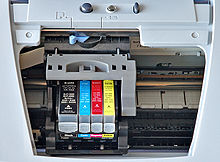
A Canon inkjet with CMYK cartridges
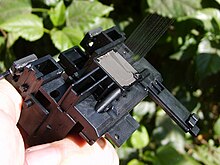
Piezoelectric printing nozzle of an EPSON C20 printer

Howtek fashion inkjet nozzle (tubular piezo non shown)
There are many ways to produce a driblet-on-demand (DOD) inkjet. Common methods include thermal DOD and piezoelectric DOD to speed upwardly the frequency of drops. DOD may use a unmarried nozzle or thousands of nozzles. One DOD procedure uses software that directs the heads to utilize between zilch and eight droplets of ink per dot, merely where needed.[ citation needed ] Inkjet fluid materials have expanded to include pastes, epoxies, hot-melt inks, biological fluids, etc. DOD is very popular and has an interesting history. Mechanical DOD came get-go, followed by electrical methods including piezoelectric devices and and so thermal or heat expansion methods.
- Thermal DOD printing
- Nigh consumer inkjet printers, including those from Canon (FINE Cartridge system, encounter photo), Hewlett-Packard, and Lexmark, utilise the thermal inkjet process.[xi] The idea of using thermal excitation to move tiny drops of ink was adult independently by two groups at roughly the same time: John Vaught and a squad at Hewlett-Packard's Corvallis Division, and Canon engineer Ichiro Endo. Initially, in 1977, Endo's squad was trying to use the piezoelectric event to move ink out of the nozzle but noticed that ink shot out of a syringe when it was accidentally heated with a soldering iron. Vaught's work started in late 1978 with a project to develop fast, depression-cost printing. The team at HP found that sparse-film resistors could produce plenty heat to fire an ink droplet. Two years later the HP and Canon teams found out about each other's piece of work.[12] [13]
- Thermal inkjet
- In the thermal inkjet procedure, the print cartridges consist of a serial of tiny chambers, each containing a heater, all of which are constructed past photolithography. To eject a droplet from each bedroom, a pulse of current is passed through the heating chemical element causing a rapid vaporization of the ink in the chamber and forming a bubble,[14] which causes a large pressure increase, propelling a droplet of ink onto the paper (hence Canon's merchandise name of Bubble Jet). Early on thermal heads ran at just 600-700 dpi[11] only improvements past HP increased the firing range of 8-12 khz per bedchamber and as high as 18khz with 5-picoliter drop book by the year 2000. Thermal printheads do not have the power of piezo DOD or continuous inkjet, so the gap between the face of the head and paper is critical. The ink'south surface tension, as well equally the condensation and resultant wrinkle of the vapor bubble, pulls a further charge of ink into the chamber through a narrow aqueduct attached to an ink reservoir. The inks involved are unremarkably h2o-based and use either pigments or dyes as the colorant. The inks must have a volatile component to form the vapor bubble; otherwise droplet ejection cannot occur. Every bit no special materials are required, the print head is mostly cheaper to produce than in other inkjet technologies.
- Piezoelectric DOD printing
- Piezos are electrically polarized ceramic devices, only as a magnet is polarized. Most commercial and industrial inkjet printers and some consumer printers (those produced by Epson (see photograph) and Brother Industries) use a piezoelectric material in an ink-filled chamber backside each nozzle instead of a heating element. When a voltage is applied, the piezoelectric material changes shape, generating a pressure pulse in the fluid, which pushes a droplet of ink from the nozzle. Unmarried nozzle tubular inkjets actually are fluid resonator chambers and the drops are expelled by audio waves in the ink bedroom. The 1972 patent called them squeeze tube inkjets merely later it was discovered to exist acoustical inkjets. Piezoelectric (also called piezo) inkjet allows a wider diversity of inks than thermal inkjet as in that location is no requirement for a volatile component, and no effect with kogation (buildup of ink balance), but the print heads are more expensive to manufacture due to the use of piezoelectric material (ordinarily PZT, lead zirconium titanate). However, the ink cartridges tin be split from the head itself and individually exist replaced as needed. Piezo, then has the potential for lower running costs. Piezo heads are said to accomplish firing rates that are faster than thermal heads at comparable drop volumes.[xi]
- Piezo inkjet
- Piezo inkjet technology is often used on product lines to marker products. For instance, the "use-earlier" date is ofttimes applied to products with this technique; in this application the head is stationary and the production moves by. This application requires a relatively large gap between the print head and the substrate, but besides yields a loftier speed, a long service life, and low operating toll.
- Thermoplastic/3D printing
- In the 1970s, the first DOD inks were water-based and college temperature use was not recommended. In the late 1970s wax and oil based inks were used in the Silonics in 1975, Siemens PT-80i in 1977 and Epson and Exxon in 1980's DOD inkjets.[eleven] In 1984 a small company, Howtek, Inc.,[v] found that solid ink[11] materials (thermoplastics) could exist jetted at 125 °C past maintaining the piezo poling charge while printing. In 1986 Howtek launched the Pixelmaster solid ink-jetting printer, which opened the door to printing 3-dimensional plastic inks and led to a 1992 3D patent, US5136515A. This patent was licensed by the start 3 major 3D printer companies (Sanders Epitome, Inc, Stratasys and 3D Systems).
- Braillemaster
- In the belatedly 1980s, Howtek introduced the Braillemaster, a printer that used four layers of solid ink per character to create documents in Braille that could be read past people who were bullheaded.
- Howtek
- Solidscape, Inc., currently uses the Howtek-style thermoplastic materials and Howtek-style unmarried nozzle inkjets (encounter illustration) very successfully. Ballistic Particle Manufacturing as well used the Howtek style materials and inkjets.[15] These inkjets can produce up to 16,000 drops per second and shoot drops at 9 feet per 2nd. Originally designed to only print on standard letter of the alphabet-sized paper sheets they now can print 3D models requiring hundreds of layers.
- Thermojet
- The thermoplastic inks in piezoelectric inkjets (called Thermojet technology by Howtek) are sometimes confused with the thermal (heat expansion) bubble-jet technology but they are completely unlike. Chimera jet inks are non solid at room temp and are not heated. Thermojet inks require 125 °C to reduce fluid viscosity in jetting range. Howtek was the first to introduce an inkjet color printer using thermoplastic inks[11] in 1984 at Comdex, Las Vegas.
Ink formulations [edit]
The earliest reference to a continuous inkjet ink (CIJ) in the 1971 patent US3596285A states " The preferred ink is characterized by viscosity and surface tension characteristics such that the liquid will be maintained over bridge under the strength with which it is moving in span or stream. Implicit in such requirement is that the pressure level practical to the ink in formation of said stream is sufficient to course a jet and to impart enough free energy to carry the jet every bit a continuous liquid mass nonetheless the defective forces which are or may exist applied. Furthermore, the color of the ink and the color of the carrier should be such that good optical dissimilarity is formed in that location betwixt the following printing. The preferred ink is a "hot-cook ink". That is to say it will assume a solid phase at the temperature of the carrier and liquid phase at some higher temperature. The range of commercially available ink compositions which could come across the requirement of the invention are not known at the nowadays time. However, satisfactory printing co-ordinate to the invention has been achieved with a conductive metallic alloy as ink. It is extremely hard at room temperature and adheres well to the surface of the carrier.
The basic problem with inkjet inks is the conflicting requirements for a coloring amanuensis that will stay on the surface versus rapid bleed through the carrier fluid.[ten]
Desktop inkjet printers, as used in offices and homes, tend to use aqueous ink[10] based on a mixture of h2o, glycol and dyes or pigments. These inks are inexpensive to manufacture but hard to control on the surface of media, often requiring peculiarly coated media. HP inks contain sulfonated polyazo black dye (normally used for dyeing leather), nitrates and other compounds.[10] Aqueous inks are mainly used in printers with thermal inkjet heads, equally these heads require water to perform the ink-expelling office.
While aqueous inks often provide the broadest colour gamut and virtually vivid colour, nearly are not waterproof without specialized coating or lamination later printing. Most dye-based inks, while usually the to the lowest degree expensive, are subject to rapid fading when exposed to light or ozone. Pigment-based aqueous inks are typically more costly but provide much better long-term durability and ultraviolet resistance. Inks marketed as "archival quality" are usually pigment-based.
Some professional broad format printers use aqueous inks, but the majority in professional use today employ a much wider range of inks, about of which crave piezo inkjet heads and extensive maintenance.
- Solvent inks
- The primary ingredient of these inks are volatile organic compounds (VOCs), organic chemical compounds that have high vapor pressures. Color is achieved with pigments rather than dyes for fantabulous fade-resistance. The chief advantage of solvent inks is that they are comparatively inexpensive and enable printing on flexible, uncoated vinyl substrates, which are used to produce vehicle graphics, billboards, banners and adhesive decals. Disadvantages include the vapour produced by the solvent and the need to dispose of used solvent. Unlike most aqueous inks, prints made using solvent-based inks are generally waterproof and ultraviolet-resistant (for outdoor use) without special over-coatings.[x] The loftier print speed of many solvent printers demands special drying equipment, usually a combination of heaters and blowers. The substrate is usually heated immediately before and after the print heads utilise ink. Solvent inks are divided into two sub-categories: hard solvent ink offers the greatest durability without specialized over-coatings only requires specialized ventilation of the printing area to avoid exposure to hazardous fumes, while mild or "eco" solvent inks, while still not as safe as aqueous inks, are intended for use in enclosed spaces without specialized ventilation of the printing surface area. Mild solvent inks accept rapidly gained popularity in recent years as their colour quality and durability take increased while ink cost has dropped significantly.
- UV-curable inks
- These inks consist mainly of acrylic monomers with an initiator packet. Afterwards printing, the ink is cured past exposure to strong UV light. Ink is exposed to UV radiation where a chemic reaction takes identify where the photo-initiators crusade the ink components to cross-link into a solid. Typically a shuttered mercury-vapor lamp or UV LED is used for the curing process. Curing processes with high ability for short periods of times (microseconds) allow curing inks on thermally sensitive substrates. UV inks exercise not evaporate, but rather cure or set as a result from this chemical reaction. No textile is evaporated or removed, which means near 100% of the delivered volume is used to provide coloration. This reaction happens very speedily, which leads to instant drying that results in a completely cured graphic in a affair of seconds. This likewise allows for a very fast print process. As a result of this instant chemic reaction no solvents penetrate the substrate in one case it comes off the printer, which allows for loftier quality prints.[16] [17] The advantage of UV-curable inks is that they "dry" as soon as they are cured, they can be applied to a wide range of uncoated substrates, and they produce a very robust image. Disadvantages are that they are expensive, require expensive curing modules in the printer, and the cured ink has a significant volume and then gives a slight relief on the surface. Though improvements are being made in the technology, UV-curable inks, considering of their volume, are somewhat susceptible to swell if applied to a flexible substrate. Every bit such, they are often used in large "flatbed" printers, which impress directly to rigid substrates such as plastic, wood or aluminium where flexibility is non a concern.
- Dye sublimation inks
- These inks contain special sublimation dyes and are used to impress straight or indirectly on to fabrics which consist of a high per centum of polyester fibers. A heating step causes the dyes to sublimate into the fibers and create an paradigm with strong color and good immovability.
- Solid ink
- These inks consist mainly of waxy compounds which are heated past their melting point to enable press, and which harden upon hit the cooled substrate. Hot-melt inks[10] are typically used for masking processes and are found in graphic printing.[v] [18] The earliest hot-melt ink was patented in 1971 by Johannes F Gottwald, US3596285A, Liquid Metal Recorder was intended for printing. The patent states "As used herein the term "printing" is non intended in a limited sense just includes writing or other symbol or pattern formulation with an ink. The term ink every bit used is intended to include non only dye or pigment-containing materials, but whatsoever flowable substance or composition suited for awarding to surface for forming symbols, characters or patterns of intelligence by marking. The materials employed in such process tin can be salvaged for reuse. Another object of the invention is to increase the size of characters.....in terms of material requirements for such large and continuous displays".
Press heads [edit]

Inkjet heads: disposable head (left) and fixed head (correct) with ink cartridge (middle)
There are two main design philosophies in inkjet head blueprint: fixed-head and dispensable caput. Each has its own strengths and weaknesses.
Fixed caput [edit]
The fixed-caput philosophy provides an inbuilt print head (ofttimes referred to as a gaiter-head) that is designed to terminal for the life of the printer. The thought is that because the head need not exist replaced every time the ink runs out, consumable costs tin can exist made lower and the head itself tin can be more precise than a cheap disposable 1, typically requiring no calibration. On the other hand, if a fixed head is damaged, obtaining a replacement head can become expensive, if removing and replacing the head is fifty-fifty possible. If the printer's head cannot exist removed, the printer itself will then need to exist replaced.
Stock-still head designs are available in consumer products, but are more likely to be found on industrial loftier-stop printers and large format plotters. In the consumer space, fixed-head printers are manufactured primarily by Epson and Canon; still, many more recent Hewlett-Packard models use a fixed-caput, such as the Officejet Pro 8620 and HP's Pagewide series[19]
Disposable head [edit]
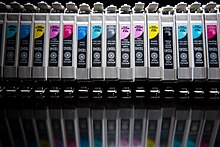
The disposable caput philosophy uses a print caput which is supplied as a part of a replaceable ink cartridge. Every time a cartridge is exhausted, the entire cartridge and impress head are replaced with a new one. This adds to the cost of consumables and makes it more difficult to manufacture a loftier-precision head at a reasonable toll, merely likewise means that a damaged or clogged impress head is only a minor problem: the user tin but buy a new cartridge. Hewlett-Packard has traditionally favoured the dispensable print head, as did Catechism in its early models. This type of construction tin also be seen as an try by printer manufacturers to stem tertiary party ink cartridge assembly replacements, as these would-be suppliers don't take the ability to manufacture specialized print heads.
An intermediate method does exist: a disposable ink tank continued to a dispensable head, which is replaced infrequently (perhaps every tenth ink tank or then). About loftier-book Hewlett-Packard inkjet printers employ this setup, with the disposable print heads used on lower volume models. A like approach is used by Kodak, where the printhead intended for permanent use is nevertheless cheap and can be replaced by the user. Canon now uses (in about models) replaceable impress heads which are designed to last the life of the printer, but can exist replaced by the user should they get clogged.
Additive manufacturing 3D printheads take very long operating "print times" and failures volition occur from internal clogs, orifice damage from bumping obstacles on the print table, scale failures from overstressed piezoelectric bond life failures and other unexpected causes. Replacement printheads are on spare parts lists for most long use-life 3D printers.
Cleaning mechanisms [edit]
Video: roofing the printhead nozzles with a rubber cap
The principal cause of inkjet press problems is ink drying on the printhead's nozzles, causing the pigments and dyes to dry out and grade a solid block of hardened mass that plugs the microscopic ink passageways. Nearly printers attempt to prevent this drying from occurring past roofing the printhead nozzles with a rubber cap when the printer is not in utilize. Abrupt power losses, or unplugging the printer before it has capped the printhead, can cause the printhead to be left in an uncapped country. Even when the head is capped, this seal is not perfect, and over a menstruation of several weeks the moisture (or other solvent) can still seep out, causing the ink to dry and harden. Once ink begins to collect and harden, the drop book can be affected, drop trajectory tin modify, or the nozzle tin completely fail to jet ink.
To combat this drying, nearly all inkjet printers include a mechanism to reapply moisture to the printhead. Typically there is no separate supply of pure ink-complimentary solvent available to practice this chore, and then instead the ink itself is used to remoisten the printhead. The printer attempts to fire all nozzles at one time, and as the ink sprays out, some of information technology wicks beyond the printhead to the dry out channels and partially softens the hardened ink. Afterward spraying, a rubber wiper blade is swept beyond the printhead to spread the wet evenly across the printhead, and the jets are again all fired to dislodge whatsoever ink clumps blocking the channels.
Some printers apply a supplemental air-suction pump, using the rubber capping station to suck ink through a severely chock-full cartridge. The suction pump machinery is oft driven past the page feed stepper motor: it is connected to the cease of the shaft. The pump simply engages when the shaft turns backwards, hence the rollers reversing while head cleaning. Due to the built-in caput design, the suction pump is too needed to prime number the ink channels inside a new printer, and to reprime the channels between ink tank changes.
Professional solvent- and UV-curable ink wide-format inkjet printers generally include a "manual make clean" mode that allows the operator to manually clean the print heads and capping mechanism and to supervene upon the wiper blades and other parts used in the automatic cleaning processes. The volume of ink used in these printers ofttimes leads to "overspray" and therefore buildup of dried ink in many places that automated processes are non capable of cleaning.
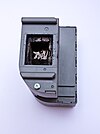
Epson Maintenance box full of used ink
The ink consumed in the cleaning process needs to be nerveless to forestall ink from leaking in the printer. The collection area is chosen the spittoon, and in Hewlett Packard printers this is an open up plastic tray underneath the cleaning/wiping station. In Epson printers, there is typically a large absorption pad in a pan underneath the newspaper feed platen. For printers several years old, it is mutual for the dried ink in the spittoon to grade a pile that tin can stack up and touch the printheads, jamming the printer. Some larger professional person printers using solvent inks may utilize a replaceable plastic receptacle to comprise waste ink and solvent which must be emptied or replaced when full.

Labyrinth air vent tubes on the elevation of an Epson Stylus Photo 5-colour ink tank. The long air channels are molded into the top of the tank and the blue label seals the channels into long tubes. The yellow label is removed prior to installation, and opens the tube ends to the atmosphere so that ink tin exist sprayed onto the newspaper. Removing the blue label would destroy the tubes and cause the moisture to quickly evaporate
There is a second type of ink drying that well-nigh printers are unable to foreclose. For ink to spray from the cartridge, air must enter to readapt the removed ink. The air enters via an extremely long, thin labyrinth tube, upward to 10 cm long, wrapping back and forth across the ink tank. The channel is long and narrow to reduce moisture evaporation through the vent tube, but some evaporation still occurs and eventually the ink cartridge dries up from the within out. To combat this problem, which is especially astute with professional fast-drying solvent inks, many wide-format printer cartridge designs contain the ink in an airtight, collapsible bag that requires no vent. The bag merely shrinks until the cartridge is empty.
The frequent cleaning conducted by some printers can eat quite a fleck of ink and has a bully bear upon on cost-per-page determinations.
Chock-full nozzles tin can exist detected by press a standard test pattern on the page. Some software workaround methods are known for re-routing printing information from a chock-full nozzle to a working nozzle.[ commendation needed ]
Ink delivery developments [edit]
Ink cartridges have been the traditional method for delivering ink to the printhead. Continuous ink arrangement (CISS) inkjet printers connect the printhead either to high-capacity ink tanks or packs, or furnish the built-in cartridges via external tanks continued via tubes, typically a retrofit configuration. Supertank printers–a subset of CISS printers–accept loftier-capacity integrated ink tanks or ink packs, and are manually refilled via ink bottles. When supertank ink systems are paired with disposable printhead technology, replaceable cartridges are used to supervene upon the exhausted print heads.
Advantages [edit]
Compared to earlier consumer-oriented colour printers, inkjet printers have a number of advantages. They are quieter in functioning than affect dot matrix or daisywheel printers. They tin print finer, smoother details through higher resolution. Consumer inkjet printers with photographic-quality printing are widely bachelor.
In comparison to technologies similar thermal wax, dye sublimation, and laser printing, inkjets have the advantage of practically no warm up time, and frequently lower cost per folio. Even so, low-cost light amplification by stimulated emission of radiation printers can have lower per-folio costs, at least for black-and-white printing, and possibly for color.
For some inkjet printers, monochrome ink sets are available either from the printer manufacturer or from tertiary-party suppliers. These let the inkjet printer to compete with the silverish-based photographic papers traditionally used in black-and-white photography, and provide the same range of tones: neutral, "warm" or "cold". When switching between full-color and monochrome ink sets, it is necessary to flush out the old ink from the print head with a cleaning cartridge. Special software or at least a modified device driver are unremarkably required, to bargain with the different colour mapping.
Some types of industrial inkjet printers are now capable of press at very high speeds, in wide formats, or for a variety of industrial applications ranging from signage, textiles, optical media,[20] ceramics and 3-D printing into biomedical applications and conductive circuitry. Leading companies and innovators in hardware include HP, Epson, Canon, Konica Minolta, FujiFilm, EFi, Durst, Brother, Roland, Mimaki, Mutoh and many others worldwide.
Disadvantages [edit]
Many "intelligent" ink cartridges contain a microchip that communicates the estimated ink level to the printer; this may cause the printer to display an error message, or incorrectly inform the user that the ink cartridge is empty. In some cases, these messages can be ignored, but some inkjet printers will refuse to print with a cartridge that declares itself empty, to forestall consumers from refilling cartridges. For example, Epson embeds a chip which prevents printing when the flake claims the cartridge is empty, although a researcher who over-rode the system found that in one case he could print up to 38% more than practiced quality pages, even though the chip stated that the cartridge was empty.[21] Third-party ink suppliers sell ink cartridges at significant discounts (at to the lowest degree 10–xxx% off OEM cartridge prices, sometimes upward to 95%, typically averaging effectually l%)[ citation needed ], and besides majority ink and cartridge cocky-refill kits at even lower prices. Many vendors' "intelligent" ink cartridges have been reverse-engineered. It is at present possible to buy inexpensive devices to reliably reset such cartridges to report themselves as full, so that they may be refilled many times.
The very narrow inkjet nozzles are prone to clogging. The ink consumed cleaning them—either during cleaning invoked by the user, or in many cases, performed automatically past the printer on a routine schedule—can account for a pregnant proportion of the ink used in the machine. Inkjet printing head nozzles tin can be cleaned using specialized solvents; or past soaking in warm distilled water for short periods of time, for water-soluble inks.
The high toll of OEM ink cartridges and the intentional obstacles to refilling them have been addressed by the growth of third-party ink suppliers. Many printer manufacturers discourage customers from using third-party inks, stating that they can damage the print heads due to not being the same formulation as the OEM inks, cause leaks, and produce inferior-quality output (e.g. of wrong color gamut). Consumer Reports has noted that some 3rd-political party cartridges may contain less ink than OEM cartridges, and thus yield no cost savings,[22] while Wilhelm Imaging Enquiry claims that with third-party inks the lifetime of prints may be considerably reduced.[23] Still, an April 2007 review showed that, in a double-blind test, reviewers generally preferred the output produced using third-party ink over OEM ink.[ citation needed ] In general, OEM inks have undergone significant system reliability testing with the cartridge and impress-caput materials, whereas R&D efforts on 3rd-party ink material compatibility are likely to be significantly less. Some inkjet manufacturers accept tried to prevent cartridges existence refilled using various schemes including fitting chips to the cartridges that log how much the cartridge has printed and prevent the performance of a refilled cartridge.
The warranty on a printer may not use if the printer is damaged by the use of non-canonical supplies. In the Usa the Magnuson–Moss Warranty Human action is a federal law which states that warrantors cannot require that only brand name parts and supplies exist used with their products, as some printer manufacturers imply. However, this would not apply if non-approved items cause damage. In the United kingdom of great britain and northern ireland, a printer manufacturer cannot lawfully impose such conditions as part of its warranty (Regina Vs Ford Motor Company refers) although many attempt to do and so illegally. Every bit long as the product used was sold every bit beingness for the printer it was used in, then the sale of goods act applies, and anything so sold must be "of merchandisable quality and fit for purpose". Moreover, under U.k. police force, it is the retailer and not the manufacturer that is legally liable, for two years on electrically operated items specifically, and as such the retailer is where one would seek redress.[24]
Durability [edit]
Inkjet documents can take poor to first-class archival immovability, depending on the quality of the inks and paper used. If low-quality paper is used, information technology tin xanthous and degrade due to residual acid in the untreated lurid; in the worst instance, old prints can literally crumble into minor particles when handled. High-quality inkjet prints on acrid-free paper tin can last as long equally typewritten or handwritten documents on the aforementioned newspaper.
Because the ink used in many low-cost consumer inkjets is h2o-soluble, care must exist taken with inkjet-printed documents to avert fifty-fifty the smallest drop of moisture, which tin can cause astringent "blurring" or "running". In extreme cases, even sweaty fingertips during hot humid weather could cause low-quality inks to smear. Similarly, h2o-based highlighter markers can blur inkjet-printed documents and discolor the highlighter's tip. The lifetime of inkjet prints produced using aqueous inks is generally shorter (although UV-resistant inks are available) than those produced with solvent-based inkjets; notwithstanding, so-called "archival inks" have been produced for utilise in aqueous-based machines which offering extended life.
In addition to smearing, gradual fading of many inks can be a problem over time. Impress lifetime is highly dependent on the quality and formulation of the ink. The earliest inkjet printers, intended for habitation and small office applications, used dye-based inks. Even the best dye-based inks are not equally durable equally pigment-based inks, which are now bachelor for many inkjet printers. Many inkjet printers now utilize pigment based inks which are highly water resistant: at least the black ink is often pigment-based. Resin or silicone protected photopaper is widely available at depression cost, introducing complete water and mechanical rub resistance for dye and pigment inks. The photopaper itself must be designed for pigment or for dye inks, equally pigment particles are too large to exist able to penetrate through dye-only photopaper protection layer.
The highest-quality inkjet prints are often called "giclée" prints, to distinguish them from less-durable and lower-cost prints. However, the use of the term is no guarantee of quality, and the inks and newspaper used must be carefully investigated before an archivist can rely on their long-term durability.
To increase the immovability of inkjet printer prints, more attention is needed for the inkjet ink cartridge. One way to treat ink cartridges on an inkjet printer is to maintain the temperature of the printer itself. Excessive variation in space temperature is very bad for printer ink cartridges. The user should prevent the printer condign too hot or also dank as the cartridges can dry up. For lasting printer efficiency, the user should ensure the surface area has a regular and steady temperature level.[ citation needed ]
Operating cost tradeoffs [edit]
Inkjets employ solvent-based inks which have much shorter expiration dates compared to laser toner, which has an indefinite shelf life.[ citation needed ] Inkjet printers tend to clog if not used regularly, whereas laser printers are much more than tolerant of intermittent use.[ citation needed ] Inkjet printers crave periodical head cleaning, which consumes a considerable amount of ink, and will drive printing costs higher especially if the printer is unused for long periods.
If an inkjet head becomes clogged, 3rd-party ink solvents/head cleaners and replacement heads are available in some cases. The toll of such items may be less expensive compared to a transfer unit for a laser printer, but the laser printer unit has a much longer lifetime between required maintenance. Many inkjet printer models at present have permanently installed heads, which cannot exist economically replaced if they become irreversibly clogged, resulting in scrapping of the entire printer. On the other hand, inkjet printer designs which use a disposable printhead usually cost significantly more than per page than printers using permanent heads.[ citation needed ] Past contrast, laser printers do not take printheads to clog or replace oft, and unremarkably can produce many more pages between maintenance intervals.
Inkjet printers have traditionally produced meliorate quality output than color laser printers when printing photographic material. Both technologies have improved dramatically over time, although the best quality giclee prints favored by artists apply what is essentially a high-quality specialized type of inkjet printer.
Business model [edit]

A mutual business model for inkjet printers involves selling the actual printer at or below production cost, while dramatically marking upwardly the cost of the (proprietary) ink cartridges (a profit model called "Freebie marketing"). Most current inkjet printers attempt to enforce this production tying past anticompetitive measures such as microchips in the cartridges to hinder the use of third-party or refilled ink cartridges. The microchips monitor usage and report the ink remaining to the printer. Some manufacturers also impose "expiration dates". When the chip reports that the cartridge is empty (or out of appointment) the printer stops printing. Even if the cartridge is refilled, the microchip will indicate to the printer that the cartridge is depleted. For many models (especially from Canon), the 'empty' condition can exist overridden past inbound a 'service code' (or sometimes only by pressing the 'start' push again). For some printers, special circuit "flashers" are available that reset the quantity of remaining ink to the maximum.[25] [26]
Some manufacturers, near notably Epson and Hewlett Packard, accept been accused of indicating that a cartridge is depleted while a substantial amount of ink remains.[27] [28] A 2007 written report found that virtually printers waste a pregnant quantity of ink when they declare a cartridge to be empty. Single-ink cartridges were found to have on average 20% of their ink remaining, though actual figures range from 9% to 64% of the cartridge's total ink capacity, depending on the brand and model of printer.[29] This problem is further compounded with the use of 1-slice multi-ink cartridges, which are declared empty as before long as one color runs low. Of groovy annoyance to many users are those printers that will reject to impress documents requiring just black ink, simply considering one or more of the color ink cartridges is depleted.
In recent years, many consumers take begun to challenge the business practices of printer manufacturers, such as charging up to The states$8,000 per gallon (US$2,100 per liter) for printer ink. Alternatives for consumers are cheaper copies of cartridges, produced past third parties, and the refilling of cartridges, using refill kits. Due to the big differences in price caused by OEM markups, there are many companies selling 3rd-party ink cartridges. Virtually printer manufacturers discourage refilling disposable cartridges or using aftermarket copy cartridges, and say that use of incorrect inks may cause poor epitome quality due to differences in viscosity, which tin affect the amount of ink ejected in a drop, and color consistency, and can damage the printhead. Even so, the use of culling cartridges and inks has been gaining in popularity, threatening the business model of printer manufacturers. Printer companies such equally HP, Lexmark, and Epson have used patents and the DMCA to launch lawsuits against third-party vendors.[30] [31] An anti-trust form-action lawsuit was launched in the United states of america against HP and office supply chain Staples, alleging that HP paid Staples $100 one thousand thousand to keep cheap tertiary-party ink cartridges off the shelves.[32]
In Lexmark Int'fifty v. Static Command Components, the Usa Court of Appeals for the Sixth Circuit ruled that circumvention of this technique does not violate the Digital Millennium Copyright Act.[33] The European Committee[ commendation needed ] too ruled this exercise anticompetitive: it volition disappear in newer models sold in the European union.[34] While the DMCA case dealt with copyright protection, companies besides rely on patent protection to prevent copying and refilling of cartridges. For example, if a company devises all of the ways in which their microchips can be manipulated and cartridges tin can be refilled and patents these methods, they can prevent anyone else from refilling their cartridges[ citation needed ]. Patents protecting the construction of their cartridges forbid the sale of cheaper copies of the cartridges. For some printer models (notably those from Catechism) the manufacturer's own microchip tin can exist removed and fitted to a compatible cartridge thereby fugitive the need to replicate the microchip (and risk prosecution). Other manufacturers embed their microchips deep within the cartridge in an effort to prevent this approach.
In 2007 Eastman Kodak entered the inkjet market with its own line of All-In-One printers based on a marketing model that differed from the prevailing exercise of selling the printer at a loss while making large profits on replacement ink cartridges. Kodak claimed that consumers could save up to 50 percent on printing by using its lower price cartridges filled with the company'south proprietary pigmented colorants while avoiding the potential problems associated with off-make inks.[35] This strategy proved unsuccessful and Kodak exited the consumer inkjet printer business in 2012.
A more than recent development is the supertank printer, which uses an integrated continuous ink system. Supertank printers are defined by their large, permanently-installed ink tanks which are filled from ink bottles. The printer itself is typically sold at a substantial premium, but ink bottles are inexpensive and contain plenty ink to print thousands of pages. Supertank printers generally transport with full bottles of ink in the box, allowing up to 2 years of printing earlier the tanks needs to be refilled. Epson pioneered this technology by launching the EcoTank range, first in Indonesia in 2010,[36] with a North American launch in 2015.[37] The supertank concept proved commercially successful,[36] and other printer manufacturers accept since launched their own lines of supertank printers, including Canon[38] and HP (which besides extended the refillable-tank concept to light amplification by stimulated emission of radiation printers).[39]
Printer types [edit]
Professional models [edit]
In addition to the widely used modest inkjet printers for home and office, there are professional inkjet printers, some for "page-width" format press and many for wide format printing. Page-width format means that the print width ranges from nigh 8.five–37 in (22–94 cm). "Wide format" means print width ranging from 24" up to 15' (near lx cm to five m). The about common awarding of folio-width printers is in printing high-volume business communications that do not need high-quality layout and color. Particularly with the addition of variable data technologies, the page-width printers are important in billing, tagging, and individualized catalogs and newspapers. The awarding of most wide format printers is in printing ad graphics; a lower-book application is printing of pattern documents past architects or engineers. Simply nowadays, there are inkjet printers for digital material printing up to 64" wide with good loftier definition image of 1440×720 dpi.[xl]
Another specialty application for inkjets is producing prepress colour proofs for printing jobs created digitally. Such printers are designed to give accurate colour rendition of how the terminal prototype will look (a "proof") when the chore is finally produced on a big volume printing such as a four-colour start lithography press. An example is an Iris printer, whose output is what the French term giclée was coined for.
The largest-book supplier is Hewlett-Packard, which supplies over 90 percent of the market for printers for press technical drawings. The major products in their Designjet series are the Designjet 500/800, the Designjet T Printer series (including the T1100 and T610), the Designjet 1050 and the Designjet 4000/4500. They also have the HP Designjet 5500, a six-color printer that is used especially for printing graphics equally well as the new Designjet Z6100 which sits at the top of the HP Designjet range and features an eight colour pigment ink system.
Epson, Kodak, and Catechism also manufacture wide-format printers, sold in much smaller numbers than standard printers. Epson has a group of 3 Japanese companies around it that predominantly use Epson piezo printheads and inks: Mimaki, Roland, and Mutoh.
Scitex Digital Printing developed high-speed, variable-data, inkjet printers for production printing, but sold its profitable avails associated with the engineering to Kodak in 2005 who now market place the printers as Kodak Versamark VJ1000, VT3000, and VX5000 printing systems. These roll-fed printers can print at upwardly to k feet per infinitesimal.
Professional high-volume inkjet printers are made by a range of companies. These printers can range in toll from US$35,000 to $2 million. Carriage widths on these units can range from 54" to 192" (well-nigh 1.4 to v 1000), and ink technologies have tended toward solvent, eco-solvent, and UV-curing with a more than contempo focus toward h2o-based (aqueous) ink sets. Major applications where these printers are used are for outdoor settings for billboards, truck sides and truck defunction, building graphics and banners, while indoor displays include point-of-sales displays, backlit displays, exhibition graphics, and museum graphics.
The major suppliers for professional high-volume, wide- and grand-format printers include: EFI,[41] LexJet, Grapo, Inca, Durst, Océ, NUR (at present part of Hewlett-Packard), Lüscher, VUTEk, Scitex Vision (now part of Hewlett-Packard), Mutoh, Mimaki, Roland DG, Seiko I Infotech, IQDEMY, Leggett and Platt, Agfa, Raster Printers, DGI and MacDermid ColorSpan (now office of Hewlett-Packard), swissqprint, SPGPrints (formerly Stork Prints), MS Printing Systems and Digital Media Warehouse.[42]
SOHO multifunction inkjet photo printers [edit]
SOHO multifunction inkjet printers for photo press use up to half dozen different inks:
- Canon: cyan, yellowish, magenta, black, paint black, gray. 1 pl thermal.[43]
- Epson: cyan, yellow, magenta, low-cal cyan, light magenta, blackness. i.five pl piezo variable. Besides with A3 paper printing,[44] or FAX and duplex ADF.[45]
Professional inkjet photo printers [edit]
Inkjet printers for professional photo printing use up to twelve unlike inks:
- Canon: photo magenta, photo cyan, yellow, magenta, cyan, red, photo blackness, matte black, gray, plus either blue, photo greyness, and one chroma optimiser for black density and uniform glossiness,[46] or light grayness, dark gray and ane chroma optimiser,[47] or green, blue, and photo grey.[48] iv pl thermal.
- Epson (10 colors from 12): brilliant magenta, yellow, cyan, orange, greenish, vivid lite magenta, light cyan, lite blackness, matte black or photo black, plus an irreversible choice of either light light grayness or violet (5 not for photo).[49] iii.5 pl piezo variable.
- HP: magenta, yellow, red, greenish, blue, lite magenta, light cyan, greyness, light gray, matte black, photograph black, and one gloss enhancer.[ citation needed ] 4 pl thermal.
They tin print an image of 36 megapixels on A3 borderless photo paper with 444 ppi.[50]
Compact photo printers [edit]
A compact photo printer is a stand up-alone inkjet printer designed to produce 4×6 or 2×3 inch prints from digital cameras. It works without the use of a reckoner. It is likewise known as a portable photo printer or a snapshot printer. Compact photo printers came on the marketplace shortly after the popularity of habitation photo press took off in the early 2000s. They were designed as an alternative to developing photos or printing them on a standard inkjet photo printer.
The bulk of compact photo printers tin only print 4" x 6" pictures. Given this limitation, they are not meant to supersede standard inkjets. Many manufacturers advertise the toll per page of photos printed on their machines; this theoretically convinces people that they can print their own pictures just as cheaply as retail stores or through online printing services. Nigh compact photo printers share a like design. They are pocket-sized units, commonly with large LCDs in order to let people to scan and edit their photos, as tin can be done on a figurer. The editing options are normally somewhat advanced, assuasive the user to crop photos, remove red heart, adjust color settings too as other functions. Compact photo printers typically feature a large number of connection options, including USB and most memory menu formats.
Compact photo printers are currently manufactured past nigh of the leading printer manufacturers such every bit Epson, Canon, HP, Lexmark and Kodak. While they have increased in popularity in recent years, they still make up a relatively small share of the inkjet printer market. LG'south Pocket Photo uses Zink thermal paper which has chemistries embedded on each inkless photo paper and the image will appear with the oestrus.[51]
Other uses [edit]
U.S. Patent 6,319,530 describes a "Method of photocopying an image onto an edible spider web for decorating iced broiled goods". In other words, this invention enables 1 to inkjet print a food-class colour photo on a birthday block's surface. Many bakeries now carry these types of decorations, which are printable using edible inks and dedicated inkjet printers.[ citation needed ] Edible ink printing can be washed using normal home use inkjet printers like Canon Bubble Jet printers with edible ink cartridges installed, and using rice newspaper or frosting sheets.[ citation needed ]
Inkjet printers and like technologies are used in the product of many microscopic items. See Microelectromechanical systems.
Inkjet printers are used to form conductive traces for circuits, and color filters in LCD and plasma displays.
Inkjet printers, specially models produced by Dimatix (now part of Fujifilm), Xennia Technology and Pixdro, are in fairly mutual employ in many labs around the world for developing alternative deposition methods that reduce consumption of expensive, rare, or problematic materials. These printers have been used in the printing of polymer, macromolecular, quantum dot, metallic nanoparticles, and carbon nanotubes. The applications of such press methods include organic thin-film transistors, organic light emitting diodes, organic solar cells, and sensors.[52] [53]
Inkjet engineering is used in the emerging field of bioprinting. They are also used for the product of OLED displays.[54]
See also [edit]
- Edgeline printing
- Inkjet solar cell
- Inkjet technology
- Inkjet transfer
- Intelligent Interweaving engineering
- ISO Standards for color ink jet printers
- Light amplification by stimulated emission of radiation printing
- Memjet
- Microfluidics
- Society for Imaging Scientific discipline and Technology
- Tonejet
- UV pinning
- Water-jet printer
References [edit]
- ^ "Ink-jet". merriam-webster.com.
- ^ "Printer / Scanner Types". Printscan.about.com. eleven July 2012. Archived from the original on 12 September 2008. Retrieved 12 September 2012.
- ^ "estimator peripherals market place worldwide from 2015 to 2021, Statista".
- ^ "Ichiro Endo bio". The Optical Gild. Retrieved 8 April 2021.
- ^ a b c Howard, 1923-2009, Robert (2009). Connecting the dots : my life and inventions, from X-rays to expiry rays. New York, NY: Welcome Pelting. p. 196. ISBN978-1-56649-957-6. OCLC 455879561.
- ^ Faulkner, A. & Shu, W. (2012). "Biological cell press technologies". Nanotechnology Perceptions. eight: 35–57. doi:10.4024/N02FA12A.ntp.08.01.
{{cite journal}}: CS1 maint: multiple names: authors list (link) - ^ Reactive Inkjet Printing, Editors: Patrick J Smith, Aoife Morrin, Imperial Gild of Chemistry, Cambridge 2018, https://pubs.rsc.org/en/content/ebook/978-1-78801-051-1
- ^ Johnson, Harald (2006). "What's In a Name: The True Story of Giclée". dpandi.com. Archived from the original on 24 Feb 2014.
- ^ "Scientific Test of Questioned Documents, Second Edition". CRC Press. 27 Apr 2006. p. 204. Retrieved ane February 2016.
- ^ a b c d e f g Kenyon, R.W. (1996). Chemistry and technology of Printing and Imaging Systems. Glasgow UK: Blackie Bookish & Professional. pp. 114–115, 119–120, 128, 131, 133. ISBN978-94-010-4265-ix.
- ^ a b c d e f Webster, Edward. (2000). Impress unchained : l years of digital printing, 1950-2000 and beyond : a saga of invention and enterprise. West Dover, VT: DRA of Vermont, Inc. pp. 53–54. ISBN0-9702617-0-5. OCLC 46611664.
- ^ "Spitting image". The Economist. nineteen September 2002.
- ^ Niels J. Nielsen (May 1985). "History of ThinkJet Printhead Development" (PDF). Hewlett-Packard Journal.
- ^ Atul, Pasare (nineteen February 2017). "How inkjet printer Work". Youtube. Archived from the original on 11 December 2021. Retrieved 28 September 2019.
- ^ Cooper, 1973-, Kenneth 1000. (2001). Rapid prototyping technology : selection and application. New York: Marcel Dekker. pp. 26–43. ISBN0-8247-0261-1. OCLC 45873626.
- ^ "A Primer on UV-Curable Inkjet Inks". Signindustry.com. 19 Apr 2012. Retrieved 12 September 2012.
- ^ "The ABCs of UV Commercial Offset Printing". Piworld.com. 1 November 2007. Retrieved 12 September 2012.
- ^ "Applications in Commercial Printing for Hot Cook Ink Jets" (PDF).
- ^ Ludington, Jake (23 February 2013). "HP OfficeJet Pro 10 Printers with PageWide". Youtube. Archived from the original on 11 December 2021. Retrieved 1 February 2016.
- ^ "The History of Information — and How to Protect its Time to come".
- ^ 'Raw deal' on printer ink, BBC, three July 2003
- ^ "Consumer Reports". Mysimon.com. Archived from the original on iv March 2016. Retrieved 12 September 2012.
- ^ "WIR Testing Finds Aftermarket Inks Are Inferior to OEM" (PDF). The Hard Copy Supplies Journal . Retrieved thirty May 2013.
- ^ Sale and Supply of Goods to Consumers Human action 1999 (as amended by Sale and Supply of Goods to Consumers Regulations 2005)
- ^ "Flake reset devices for inkjet cartridge fries". Pocket-size Business organization. Chron.com. Retrieved xiii October 2014.
- ^ "Refilling Epson cartridges 1". Archived from the original on 16 October 2014. Retrieved 13 October 2014.
- ^ "Settlement in Epson Class-Action Suit Gets Initial Approval". 1105 Media Inc. 3 May 2006. Archived from the original on 28 December 2008. Retrieved 13 Baronial 2009.
- ^ "United states of america woman sues over ink cartridges". BBC. 24 Feb 2005. Retrieved thirteen August 2009.
- ^ Fisher, Ken (xviii June 2007). "Report: Inkjet printers are filthy, lying thieves". Ars Technica . Retrieved 13 August 2009.
- ^ Niccolai, James (22 February 2005). "Court Won't Block Low-Toll Cartridges". PC Globe Communications, Inc . Retrieved 13 August 2009.
- ^ Vocaliser, Michael (xx October 2005). "HP cracks downwards on cartridge refill industry". CBS Interactive. Retrieved 13 August 2009.
- ^ Paul, Ryan (18 December 2007). "$8,000-per-gallon printer ink leads to antitrust lawsuit". Ars Technica . Retrieved 13 August 2009.
- ^ Karl South. Forester (27 February 2003). "Lexmark International, Inc. five. Static Command Components, Inc.: Findings of Fact and Conclusions of Law" (PDF). The states District Court for the Eastern Commune of Kentucky. Archived from the original (PDF) on 30 June 2006. Retrieved eight Baronial 2006.
- ^ "Printer makers rapped over refill restrictions". News.zdnet.co.britain. 20 Dec 2002. Retrieved 12 September 2012.
- ^ "Kodak'south Moment of Truth". Businessweek. 18 February 2007. Archived from the original on 5 November 2012. Retrieved 12 September 2012.
- ^ a b Epson (6 July 2016). "Epson High-Chapters Ink Tank Printers Achieve Cumulative Global Sales of 15 Million Units". Retrieved 25 June 2021.
- ^ Epson (4 August 2015). "Epson Transforms Printer Category with EcoTank – Loaded and Ready to Print for Up to Ii Years Without an Ink Refill". Retrieved 25 June 2021.
- ^ Canon U.S.A., Inc. (3 Dec 2019). "Feel Mega Value with New Canon PIXMA Thou-Serial MegaTank Printer". Retrieved 25 June 2021.
- ^ HP Inc. (29 May 2019). "HP Debuts Earth's First Toner Tank". Retrieved 25 June 2021.
- ^ Budi Prasetyo (25 April 2015). "Dengan Printer Kain Dye-Sub Terbaru Epson Memasuki Dunia Style dan Tekstil".
- ^ Electronics For Imaging, Inc. (17 February 2015). "EFI and Konica Minolta Concern Solutions Establish Wide-Format Printer Distribution Understanding". GlobeNewswire News Room.
- ^ "Digital Media Warehouse". Digital Media Warehouse.
- ^ "Canon PIXMA MG7700 Series". Retrieved xi August 2016.
- ^ "Expression Photo XP-950". Retrieved 10 Baronial 2016.
- ^ "Epson Expression Photo XP-850 Modest-in-One® All-in-One Printer". Retrieved 10 August 2016.
- ^ "Canon imagePROGRAF PRO-1000 Specification". Retrieved x August 2016.
- ^ "Canon launches the flagship PIXMA PRO-1 – ultimate quality A3+ printer for photographers". Retrieved 13 January 2014.
- ^ "Canon imagePROGRAF iPF9000 Specifications". Retrieved 10 August 2016.
- ^ "Epson SureColor P7000 | P9000". Retrieved 13 August 2016.
- ^ "Canon PIXMA PRO-10 A3+ Professional Printer Review". Retrieved 12 January 2014.
- ^ "LG unveils Pocket Photo 2, letting y'all impress photos from your smartphone". 24 June 2011. Retrieved 30 December 2013.
- ^ M. Singh et al., "Inkjet Press – Procedure and Its Applications", Advanced Materials, 2009, doi:ten.1002/adma.200901141
- ^ Lennon, Alison J.; Utama, Roland Y.; et al. (2008). "Forming openings to semiconductor layers of silicon solar cells by inkjet press". Solar Energy Materials and Solar Cells. 92 (xi): 1410–1415. doi:ten.1016/j.solmat.2008.05.018.
- ^ "OLED ink jet press: introduction and market place status | OLED-Info". world wide web.oled-info.com.
Farther reading [edit]
- Hutchings, Ian M.; Martin, Graham D., eds. (Dec 2012). Inkjet Engineering science for Digital Fabrication. Cambridge: Wiley. ISBN978-0-470-68198-5.
External links [edit]
- Inkjet printing, data video from the University of Sheffield
Source: https://en.wikipedia.org/wiki/Inkjet_printing
0 Response to "Does Hp Printer L7650 Have Problem With Giving False Reading Bad Printheads"
Postar um comentário